Ship:Ning Hai
Pockington (talk | contribs) mNo edit summary |
Pockington (talk | contribs) fixed rudder shift, torpedo stats, |
||
| Line 46: | Line 46: | ||
| style="color:inherit;" | • Turning circle radius (m) || style="color:inherit;" | 390 | | style="color:inherit;" | • Turning circle radius (m) || style="color:inherit;" | 390 | ||
|- | |- | ||
| style="color:inherit;" | • Rudder-shift time (sec) || style="color:inherit;" | | | style="color:inherit;" | • Rudder-shift time (sec) || style="color:inherit;" | 3.6 | ||
|} | |} | ||
</div> | </div> | ||
| Line 149: | Line 149: | ||
! style="background-color:#1a3244; color:#ffffff; font-weight:bold;" | TORPEDO LAUNCHERS !! style="background-color:#1a3244; color:#ffffff; font-weight:bold;" | | ! style="background-color:#1a3244; color:#ffffff; font-weight:bold;" | TORPEDO LAUNCHERS !! style="background-color:#1a3244; color:#ffffff; font-weight:bold;" | | ||
|- | |- | ||
| style="color:inherit;" | • Number of launchers || style="color:inherit;" | | | style="color:inherit;" | • Number of launchers || style="color:inherit;" | 2x2 | ||
|- | |- | ||
| style="color:inherit;" | • Torpedo name || style="color:inherit;" | 533 Type 6 | | style="color:inherit;" | • Torpedo name || style="color:inherit;" | 533 Type 6 | ||
| Line 165: | Line 165: | ||
| style="color:inherit;" | • Detectability (km) || style="color:inherit;" | 1.2 | | style="color:inherit;" | • Detectability (km) || style="color:inherit;" | 1.2 | ||
|- | |- | ||
| style="color:inherit;" | • Flooding chance (%) || style="color:inherit;" | | | style="color:inherit;" | • Flooding chance (%) || style="color:inherit;" | 175% | ||
|} | |} | ||
</div> | </div> | ||
Latest revision as of 20:23, 3 July 2026

III
2,500 doubloons
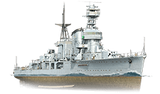
Ning Hai — Pan-Asia Premium Tier III Cruiser.
In 1931, the Japanese Harima shipbuilding company laid down two mini-cruisers—Ning Hai and Ping Hai—for the needs of the Chinese Navy, both based on cruiser Yūbari. Ning Hai was built in Japan and became part of the Chinese fleet in 1932. Both Chinese cruisers were sunk by Japanese aircraft at the start of the Sino-Japanese War in 1937. Between 1938 and 1943, Ning Hai served as floating barracks in the Sasebo Naval Arsenal. In 1944, she was repaired and converted into an escort ship named Ioshima. On September 19, 1944, the former Chinese cruiser took a torpedo hit from USS Shad and sank.
Pros
- Torpedoes are available.
- Comfortable main battery shell ballistics.
Cons
- Low rate of fire on the main battery.
- Low survivability.
Ship Stats
Hull Information
Main Battery
Torpedoes
AA Defense
Compatible Upgrades
| Slot 1 |
 |
 |

|
|---|---|---|---|
| Slot 2 |
 |

|
Consumables
- Slot 1: Damage Control Party
 (5.0s action, 60.0s cooldown)

