Ship:Agincourt
Automated stats update via wiki pipeline |
No edit summary |
||
| Line 5: | Line 5: | ||
===Pros=== | ===Pros=== | ||
* | * High secondary battery gun accuracy | ||
* | * Long secondary battery gun firing range | ||
* Low detectability | |||
===Cons=== | ===Cons=== | ||
* | * No AA defense | ||
* | * Low maneuverability | ||
* Low speed | |||
| Line 262: | Line 263: | ||
<gallery> | <gallery> | ||
File:Agincourt.png | |||
</gallery> | </gallery> | ||
</div></div></div> | </div></div></div> | ||
Revision as of 03:08, 6 July 2026

V
3,500 doubloons
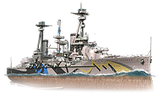
Agincourt — U.K. Premium Tier V Battleship.
Brazilian dreadnought Rio de Janeiro was laid down in 1911 in Elswick, but Brazil canceled its construction due to the deteriorating economic situation. The ship was bought by the Ottoman Empire—she was supposed to become part of the Turkish Fleet under the name Sultan Osman I. However, amid the outbreak of World War I, Rio de Janeiro was "leased" by the British government and entered service as HMS Agincourt. In 1916, the ship took part in the Battle of Jutland, where she managed to hit German ships several times.
Pros
- High secondary battery gun accuracy
- Long secondary battery gun firing range
- Low detectability
Cons
- No AA defense
- Low maneuverability
- Low speed
Ship Stats
Hull Information
Main Battery
Secondary Battery
Airstrike
Compatible Upgrades
| Slot 1 |
 |
 |

|
|---|---|---|---|
| Slot 2 |
 |

| |
| Slot 3 |
 |
 |

|
Consumables
- Slot 1: Damage Control Party
 (15.0s action, 80.0s cooldown)
 - Slot 2: Repair Party
 (4 charges, 28.0s action, 80.0s cooldown, 242 hp/s)

